How to Tell If Your Car Needs Paint Correction, Polishing, or Both

Your car looked stunning when you drove it off the lot. Now, under direct sunlight, the paint looks dull, hazy, or criss-crossed with fine lines you can’t explain. You’ve heard the terms “polishing” and “paint correction” — but you’re not sure which one applies to your car, or if you need both.
This guide cuts through the confusion. You’ll learn to identify exactly what’s happening to your paint, understand what each service actually does, and know which one (or combination) your car needs before you spend a dollar.
Key Takeaways
- Polishing removes light surface contamination and minor oxidation; paint correction removes scratches, swirl marks, and deeper defects through abrasive compounding.
- The depth of a scratch determines the right treatment — if it catches your fingernail, it likely needs correction, not just polish.
- Most vehicles driven more than two years benefit from both services performed together.
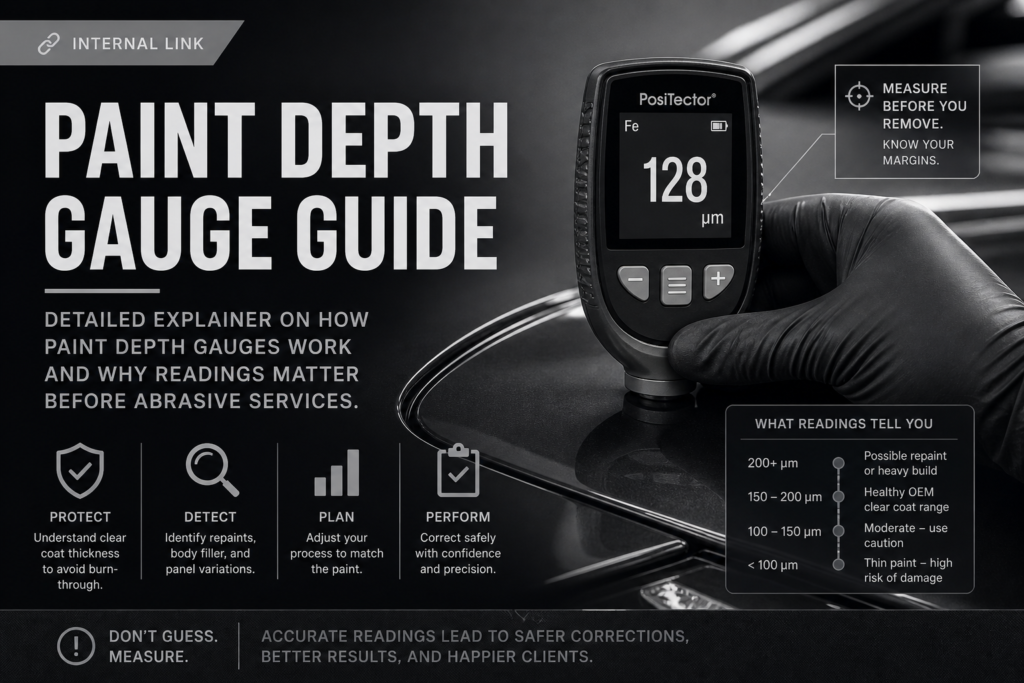
- A professional paint inspection (paint depth gauge + lighting assessment) is the only way to confirm defect depth before committing to a service.
What Are Swirl Marks — and Do You Actually Have Them?
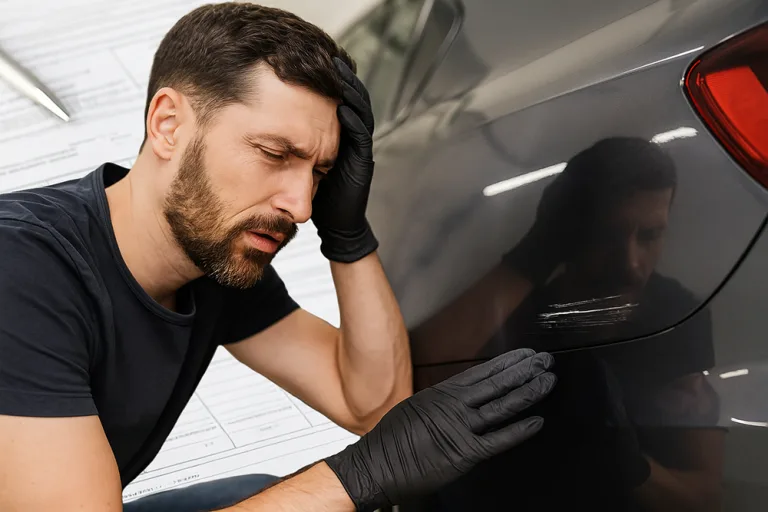
Swirl marks are the most common paint complaint detailing professionals encounter, and most car owners don’t realize how widespread they are. They appear as circular or web-like scratches in the clear coat, almost always caused by improper washing technique — automatic car washes, dirty wash mitts, or wiping a dusty hood with a dry cloth.
Here’s the quick test: Take your car outside in bright, direct sunlight (or use a single bright LED work light in a garage). Hold the light at a low angle across the hood or roof. If you see swirling, web-like patterns radiating outward — especially around the center of panels where most wiping occurs — you have swirl marks. <!– [PERSONAL EXPERIENCE] –>
Professional observation: Swirl marks appear on virtually every vehicle that has been through a tunnel car wash more than a handful of times. The rotating brushes in automatic washes are among the leading causes of fine-scratch accumulation in the clear coat.
Swirl marks live in the clear coat — the top layer of your paint system — and are generally shallow enough to be addressed with polishing alone, unless they’ve been building up for years without treatment.
Show Image
What’s the Difference Between Polishing and Paint Correction?
Polishing and paint correction are often used interchangeably, but they’re genuinely different services with different tools, compounds, and levels of paint removal.
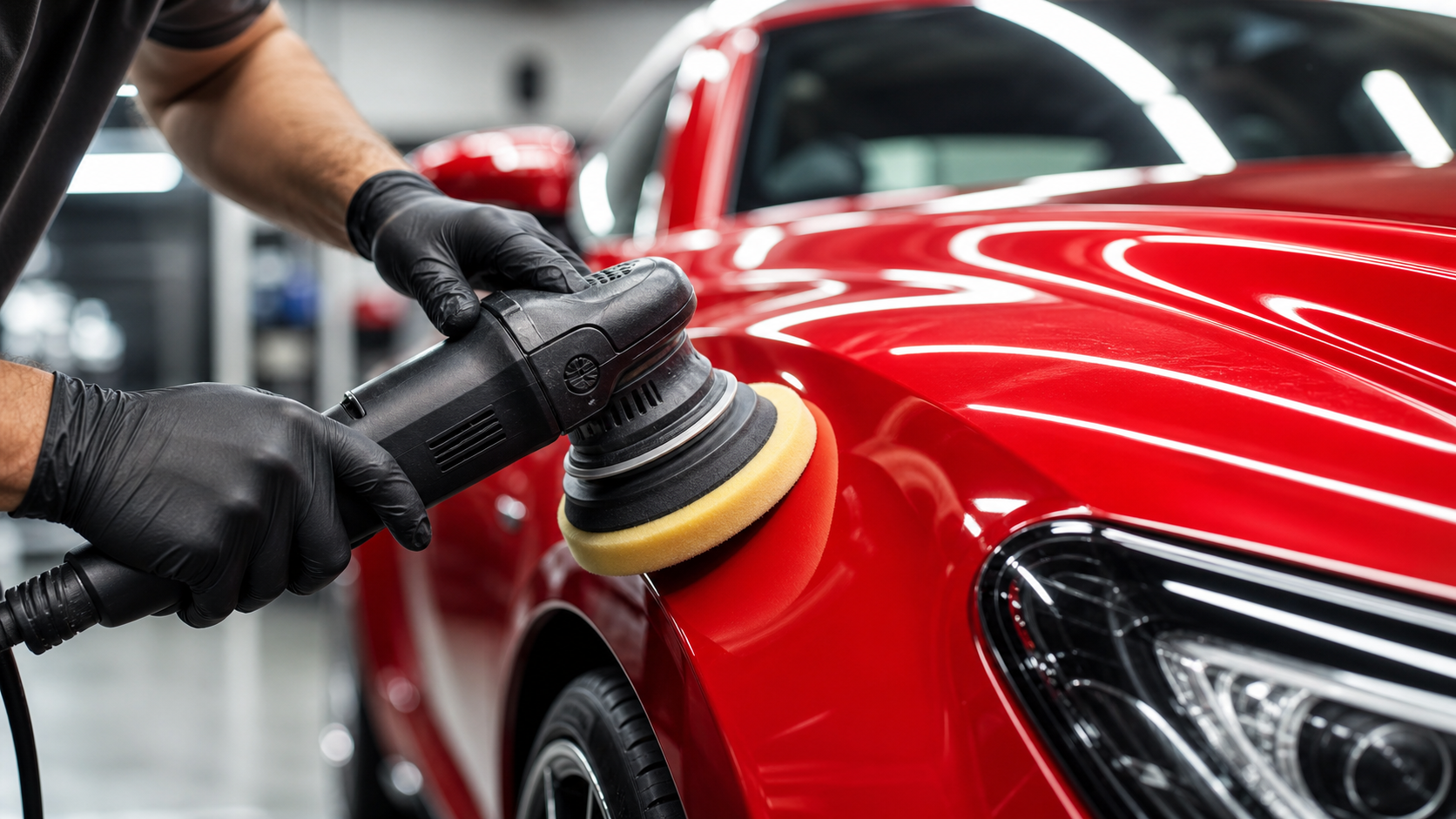
Polishing uses a mild abrasive polish applied with a dual-action (DA) polisher. It smooths the very top of the clear coat, removing light surface oxidation, water spots, light swirl marks, and fine scratches. Think of it as resurfacing a small area of wear without removing significant material. A polish pass typically removes 1-3 microns of clear coat.
Paint correction is a multi-stage process involving progressively finer cutting compounds and polishes on a rotary or forced-rotation machine. It removes deeper swirl marks, RIDS (random isolated deep scratches), marring, and moderate oxidation by leveling the clear coat around the defect. A full two-stage correction can remove 5-15+ microns of clear coat depending on severity. <!– [UNIQUE INSIGHT] –>
According to industry professionals, the average passenger vehicle has a clear coat between 30-50 microns thick. That means you have limited correction cycles over the life of the paint — which is exactly why a paint depth gauge reading before any abrasive work is not optional; it’s essential.
How to Read Your Paint’s Defects in the Right Light
The type of lighting you use completely changes what you see. This is why so many car owners (and even some detailers) underestimate or overestimate paint damage.
Single direct light (one LED panel or shop light): Best for revealing swirl marks, holograms, and random scratches. Move the light slowly across the panel and watch what changes. Swirl marks will rotate and shift in circular patterns.
Sunlight at a low angle: The gold standard for catching oxidation, water spot etching, and widespread marring. Early morning or late afternoon light grazing across a flat panel reveals haziness that overhead noon sun hides.
Overhead fluorescent lighting: Worst for defect inspection — it hides most clear coat damage. This is why cars can look perfect in a showroom and disappointing outside.
Do this evaluation before booking any service. It takes five minutes and can save you from paying for paint correction when polishing would suffice, or from polishing a car that actually needs correction.
Which Defects Need Correction vs. Polishing?
Not all paint damage is equal, and matching the treatment to the defect depth is how you protect your clear coat’s long-term health.
Polish-only defects (shallow clear coat damage):
- Light swirl marks from washing
- Minor water spots (not etched)
- Slight surface oxidation or dullness
- Fresh bird dropping hazing (no etching)
- Fingerprint oils and fine surface contamination
Paint correction defects (mid-to-deep clear coat damage):
- Swirl marks that remain visible after a polish test spot
- RIDS (random isolated deep scratches)
- Buffer trails or holograms from a previous poor polish job
- Heavy water spot etching
- Moderate-to-severe oxidation (chalky, faded sections)
- Marring from clay bar or surface prep
Beyond correction (into the base coat or primer):
- Scratches that catch a fingernail firmly
- Paint chips with exposed metal
- Deep key scratches or parking lot gouges
These require spot repair, touch-up paint, or panel respray — not polishing or correction alone.
Our finding: In our experience inspecting vehicles before detailing services, roughly 60% of clients who come in requesting a simple “polish and wax” actually have defects requiring at least a single-stage correction to achieve the mirror finish they’re expecting. Setting expectations with a proper pre-inspection prevents disappointment and rework.
When Does Your Car Need Both Polishing and Paint Correction?
The short answer: most multi-year-old vehicles need both, performed in the correct order.
Paint correction comes first. It uses cutting compounds to remove the defects and level the clear coat. This process, by nature, leaves behind micro-marring from the cutting compound itself — the surface looks corrected but isn’t fully refined yet.
Polishing comes second. After the correction stage, a finishing polish refines the surface, removes any remaining micro-marring, and brings out the full gloss and clarity. Without this step, correction results often look hazy or slightly dull under certain lighting.
This is why a professional two-stage correction (cut + polish) delivers results that look dramatically different from either service alone. The cut removes the damage; the polish brings the clarity.
Signs your car needs both:
- It’s been more than two years since any paint work
- You have visible swirls AND deeper random scratches in the same panels
- The paint looks corrected in some spots but hazy in others
- A previous detailer left buffer trails or holograms
Frequently Asked Questions
Can I just polish my car at home to remove swirl marks?
Polishing at home with a DA polisher can remove light swirl marks effectively — but only if the marks are genuinely shallow. If you apply a finishing polish to deeper scratches, you’ll temporarily fill them with polish oils (they’ll look better wet, disappear when dry). For accurate results, do a test spot and evaluate under a single-panel light.
How long does paint correction last?
- A professional paint correction, followed by a ceramic coating or high-quality sealant, can maintain results for 2-5 years with proper wash technique. Without protection, a corrected surface will begin accumulating new swirl marks within months of normal washing.
Is paint correction worth it on an older or high-mileage car?
- It depends on the clear coat thickness remaining. A paint depth gauge reading confirms whether enough clear coat exists for safe abrasive work. On well-maintained paint with good thickness, correction on a high-mileage car is absolutely worthwhile — especially before applying a ceramic coating to lock in the result.
What’s the first step before booking any paint service?
- A paint inspection. A technician uses a paint depth gauge and inspection lighting to assess defect depth, clear coat thickness, and overall panel condition. This 20-30 minute assessment determines exactly which service your car needs — and prevents you from paying for more (or less) than the situation requires.

Is Your Car Ready for a Paint Inspection?
Knowing whether your car needs polishing, correction, or both starts with a professional eye and the right tools — not guesswork. A paint depth gauge, a panel light, and a trained technician will tell you exactly where your paint stands and what it will take to restore it.
Book a paint inspection today. Our team will assess your clear coat thickness, identify defect types and depth, and give you a straight recommendation — no upselling, no surprises. You’ll leave knowing exactly what your paint needs and what it will cost.